
Mental Health Myths in Indian Society—and Why They Persist
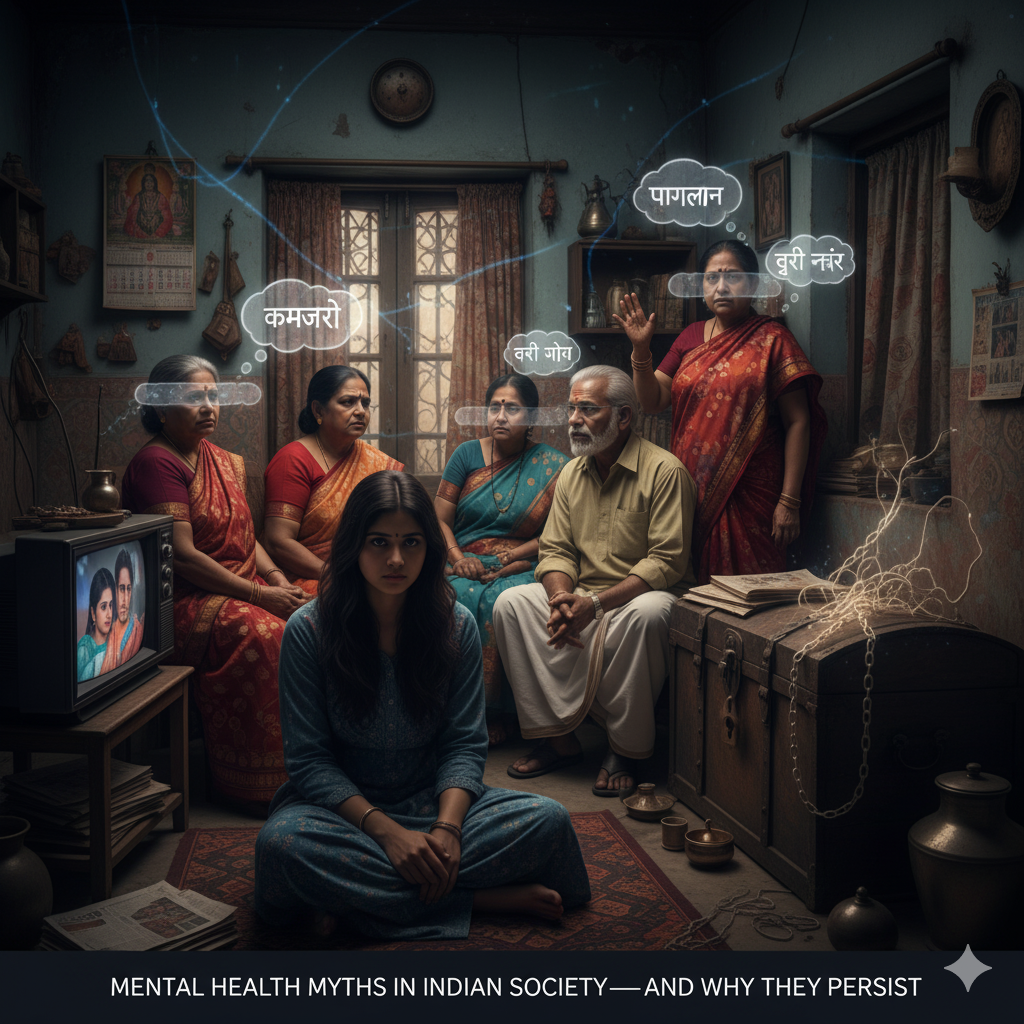
Mental health remains misunderstood across many parts of India. Although awareness is growing, several long-held beliefs continue to shape how people view emotional struggles. These misconceptions often stop individuals from seeking timely help. As a result, stigma becomes even stronger and recovery becomes harder. Understanding these myths is the first step toward building a healthier and more compassionate society. Myth 1: “Mental illness is a sign of weakness” Many still believe that struggling mentally means someone is “weak.” In reality, mental health disorders are medical conditions. They affect the brain, body, and daily functioning—just like any physical illness. Why this myth persists Generations were taught to hide emotions Social pressure to appear strong Limited understanding of mental health Myth 2: “Only extreme cases need therapy” Some people think therapy is required only when things become unmanageable. However, therapy is helpful much earlier. It supports stress management, emotional regulation, relationship issues, and personal growth. Why this myth persists Few mental health professionals, especially in rural areas Media shows therapy only in severe situations Fear of social judgment Myth 3: “Willpower alone can cure mental illness” Many assume that mental health problems can be solved simply by “thinking positive.” Although mindset helps, it is not enough. Conditions like anxiety, depression, OCD, or PTSD require structured treatment. Why this myth persists Habit of invalidating emotions Confusion between sadness and clinical disorders Lack of brain-science awareness Myth 4: “Mental illness is caused by supernatural forces” In several communities, emotional distress is linked to evil spirits, black magic, or bad karma. Therefore, many people choose faith-based solutions before seeking medical care. Why this myth persists Strong traditional beliefs Reliance on spiritual healers Limited access to scientific education Myth 5: “Talking about mental health brings shame” Silence remains one of the biggest barriers. Families avoid discussing these issues because they fear what relatives or society might say. Consequently, people suffer alone rather than seeking help. Why this myth persists Worry about social reputation Cultural pressure to appear “normal” Concerns about marriage prospects Myth 6: “Children and teens cannot have mental health issues” Some parents believe young people are “too young” to face emotional challenges. Yet mental health concerns can appear at any age. Early identification reduces long-term impact. Why this myth persists Lack of awareness of child psychology Misinterpreting symptoms as “phase” or “attention-seeking” Assumption that only adults face real challenges How We Can Break These Myths Fortunately, change is possible. When we talk openly about mental health, misconceptions slowly fade. Schools, workplaces, and families can play a major role in spreading awareness. Additionally, accessible therapy and reliable information help people seek treatment without fear. Final Thoughts Mental health myths have shaped Indian society for generations. Still, with consistent awareness, supportive communities, and science-based information, these myths can gradually disappear. When we replace judgment with understanding, we create a world where people feel safe to ask for help—and to heal.
Couples Therapy During Major Life Transitions

“We used to be so connected—what happened?” Life transitions—whether joyful, challenging, or unexpected—can shake even the strongest relationships. From career changes and moving cities to becoming parents or facing infertility, these transitions bring emotional stress, changing roles, and uncertainty. In these moments, couples therapy can become a powerful tool—not because your relationship is broken, but because it deserves support. What Counts as a “Major Life Transition”? Any event that significantly changes the way you live, think, or interact can be a life transition. These include: Getting married or moving in together Having a child (or trying to conceive) Experiencing miscarriage or infertility Job loss, career shifts, or financial strain Chronic illness or mental health diagnosis Caring for aging parents Relocating to a new city or country Retirement or empty nest syndrome Even positive changes (like promotions or having a baby) can cause emotional disconnection if not navigated together. Why Do Transitions Challenge Relationships? When life changes, dynamics shift: Communication patterns may break down Expectations may become misaligned Emotional needs may go unmet Stress responses may differ (one partner may shut down, the other may seek closeness) Old wounds or unresolved issues may resurface under pressure What once worked between you may no longer serve your relationship in this new phase. How Couples Therapy Can Help 1. Improves CommunicationTherapy teaches couples to speak honestly and listen without defensiveness. You learn to express needs, fears, and frustrations in healthy ways. 2. Builds Emotional ResilienceA therapist helps both partners explore their individual experiences of the transition—and how to emotionally support one another. 3. Clarifies ExpectationsMisunderstandings often stem from unspoken assumptions. Therapy uncovers those hidden beliefs and re-aligns them. 4. Reconnects IntimacyDuring stressful changes, emotional and physical closeness can fade. Therapy rebuilds connection through vulnerability, empathy, and shared goals. 5. Provides a Safe SpaceTherapy becomes a neutral zone where neither partner feels blamed or judged—only heard and guided. Real-Life Examples After childbirth: One partner feels overwhelmed with new responsibilities, while the other feels emotionally distant. During infertility: One withdraws in grief, the other overcompensates. Neither knows how to bridge the silence. After relocation: Career sacrifices cause resentment, while both struggle to adjust to a new routine. In each case, therapy doesn’t “fix” problems—but helps the couple work together to navigate them with more understanding and less conflict. Is Couples Therapy Right for You? You don’t need to be on the verge of separation to benefit. Consider therapy if: You’ve noticed increased arguments or silence You feel emotionally disconnected You’re struggling to support each other through change You want to strengthen your bond before or during a transition Seeking support is a sign of commitment—not failure. Final Thought: Change Can Strengthen Love Every couple faces storms. It’s not about avoiding the rain—but learning how to hold the umbrella together. If you’re in the midst of a life transition and feel your relationship shifting, know this: therapy can help you reconnect, rediscover, and rebuild—together. Book a Session with Dr. Soumya Dash As a psychiatrist who understands both individual and relationship dynamics, Dr. Dash offers compassionate support to couples navigating stress, change, and emotional distance. 📅 Schedule your appointment today and start the journey toward healing and deeper connection.